Shipping Guide Basics: Everything You Need to Know
Shipping guide feels simple until you’re standing at a counter with a box in your hands, staring at a form full of unfamiliar terms. Zones, dimensional weight, declared value, insurance tiers — none of it is complicated on its own, but nobody explains it clearly in one place. Most people just wing it, overpay, or get a package rejected at the counter because a box was an inch too big.
This shipping guide breaks down the whole process in plain language, from the difference between shipping and delivery to how carriers actually calculate what you owe. Whether you’re mailing a birthday gift or running a small online shop, this should clear up the confusion.
Shipping vs Delivery
People use these two words interchangeably, but they describe two different halves of the same journey.
Shipping refers to everything that happens from the moment a package leaves the sender until it reaches the destination network — packing, labeling, carrier pickup, transit through sorting facilities, and movement between hubs. It’s the logistics side, the part that happens mostly out of sight.
Delivery is the final leg — the moment the package actually arrives at the recipient’s door, mailbox, or pickup location. It’s the last mile, quite literally.
Why the distinction matters: shipping costs are usually calculated based on distance, weight, and speed of transit, while delivery issues (missed delivery, left at wrong address, signature required) are a separate category of problem entirely. When a package is “in transit,” it’s mid-shipping. When it’s “out for delivery,” it’s crossed into the delivery phase. Understanding this split helps when troubleshooting — a shipping delay usually means a hub backlog, while a delivery problem usually points to something local, like a courier’s route or a wrong address.
Retailers also treat the two differently in policy language. “Ships within 2 business days” refers to how fast the item leaves the warehouse. “Delivery in 3-5 days” refers to how long the trip itself takes once it’s shipped. Reading the fine print with this distinction in mind avoids a lot of confusion about why an order that “shipped” three days ago still hasn’t shown up.
Shipping Label
A shipping label is the single most important piece of paper attached to any package. It’s what tells the carrier’s automated systems (and the humans working alongside them) exactly where the package is going, how it’s being sent, and how to track it.
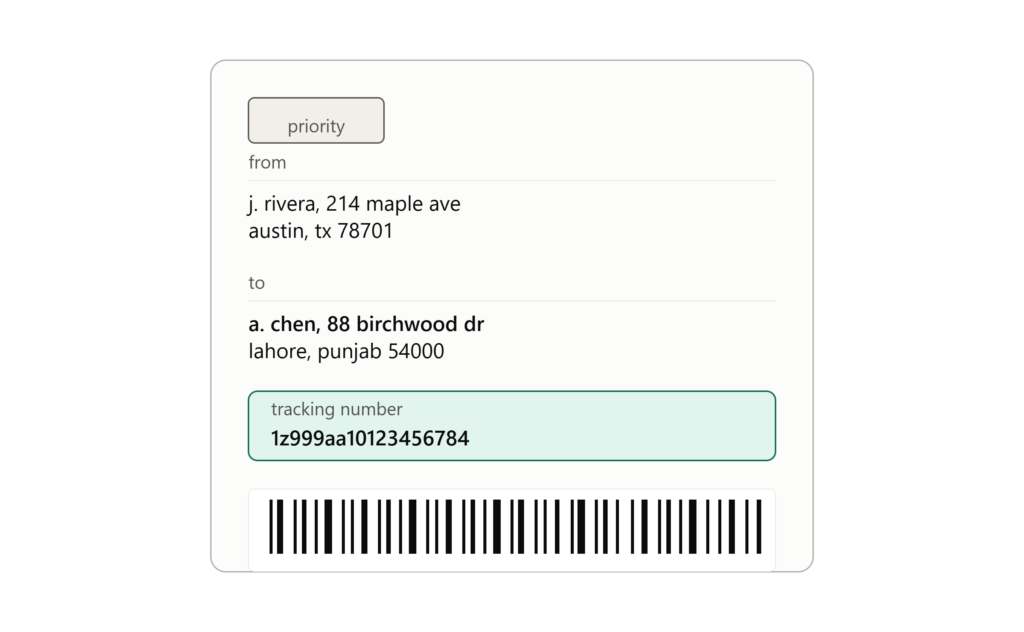
A standard shipping label typically includes:
- Sender and recipient addresses – Full name, street address, city, postal code, and often a phone number for delivery coordination.
- Tracking barcode and number – A unique identifier scanned at every checkpoint (covered in detail in our tracking guide, but worth mentioning here since it originates on the label).
- Service type – Ground, express, overnight, economy, and so on, which determines routing priority.
- Weight and dimensions – Used to calculate cost and, in some cases, printed directly on the label for quick verification at sorting facilities.
- Postage or shipping class indicator – A visual marker (often a stamp-style graphic) showing the label is valid and paid for.
- Special handling icons – Fragile, this-side-up, hazardous material, or signature-required markers when applicable.
A few practical tips: labels need to be printed clearly and attached flat, without wrinkles or tape covering the barcode, since a scanner that can’t read the code will stall the package at the very first checkpoint. If you’re shipping in bulk, most carriers offer label-printing software or browser tools that let you batch-generate and download PDFs, which saves a lot of manual entry compared to filling out a label by hand for every box.
Shipping Insurance
Shipping insurance covers the cost of a package if it’s lost, damaged, or stolen in transit. It’s optional on most shipments, though certain carriers automatically include a small baseline amount of coverage (often $50-$100) with standard service, with the option to purchase additional coverage for higher-value items.
A few things worth knowing:
- Declared value matters. Insurance payouts are typically based on what you declare the contents are worth, not what you paid for shipping. Under-declaring to save a few dollars on premiums can backfire if you ever need to file a claim.
- Proof of value helps. Receipts, invoices, or photos of the item before packing can speed up a claims process considerably if something goes wrong.
- Packaging quality affects claims. Carriers can and do deny claims if they determine the item wasn’t packaged adequately for its fragility. A single layer of bubble wrap around glassware, for instance, might not hold up to scrutiny.
- Third-party insurance exists. Beyond what carriers offer directly, independent shipping insurance providers sometimes offer better rates or broader coverage, particularly useful for businesses shipping high volumes or high-value goods regularly.
- Not everything is covered. Most policies exclude cash, jewelry above a certain value, and items packed improperly. Always check the fine print before assuming a costly item is fully protected.
For anyone selling online regularly, insurance isn’t just a safety net for the buyer — it protects your margins too. A single uninsured lost shipping guide can wipe out the profit from several successful ones.
Shipping Zones
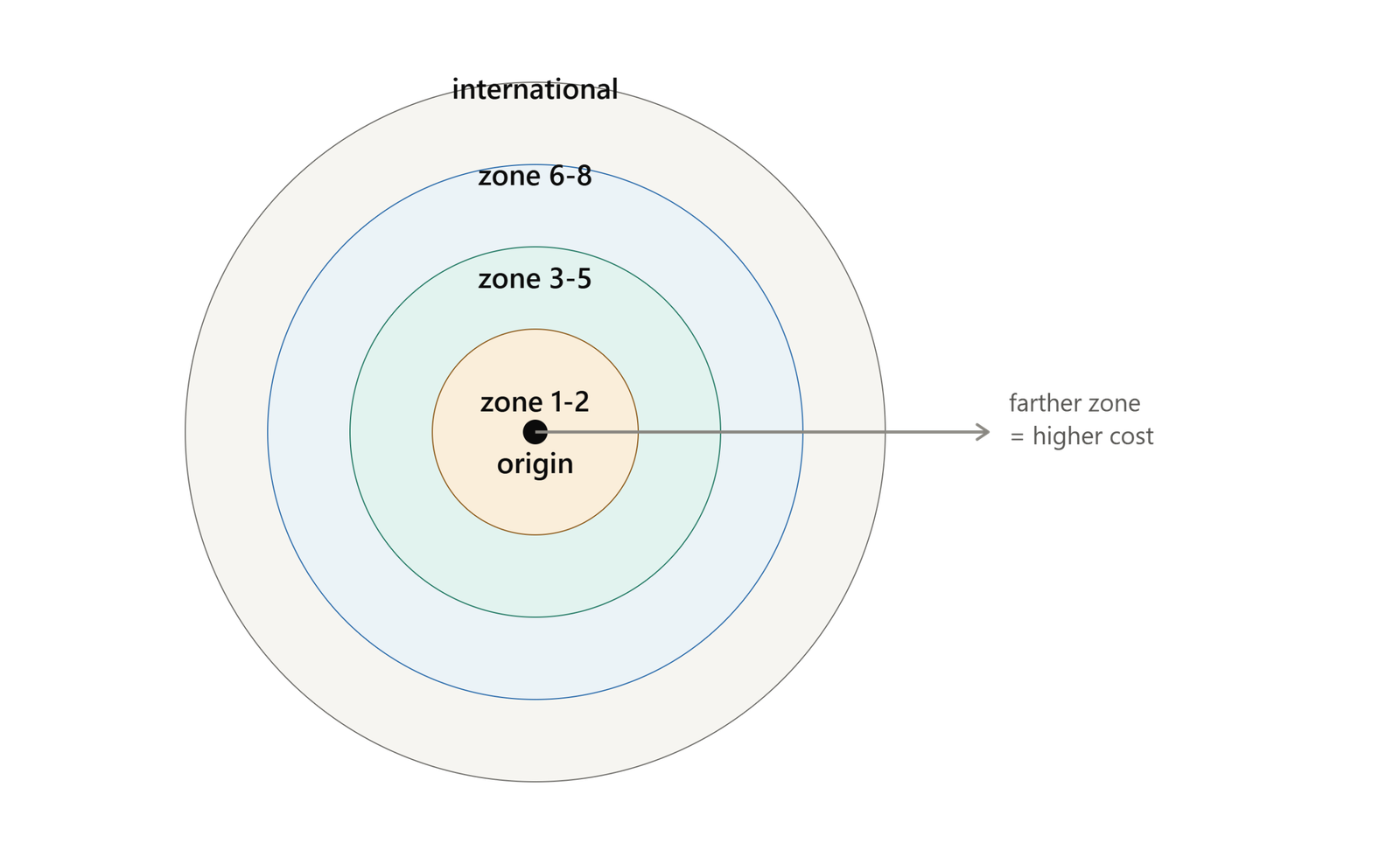
Shipping zones are geographic bands carriers use to calculate distance-based pricing. Rather than pricing every shipment individually based on exact mileage, carriers divide the country (or world) into numbered zones radiating outward from the package’s origin point.
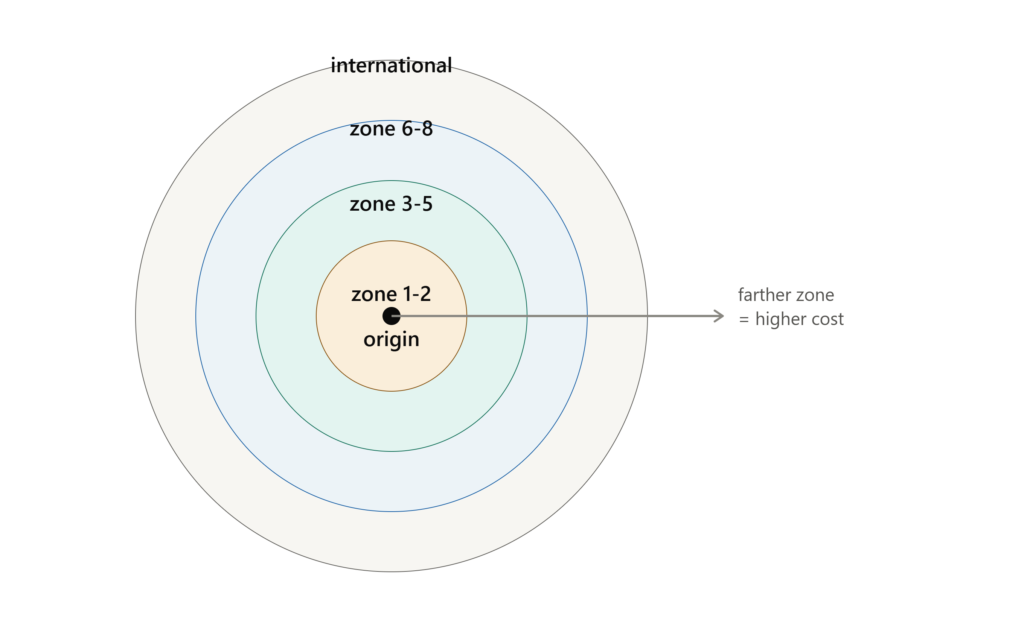
Here’s the general logic:
- Zone 1-2 covers local or very short-distance shipping, often within the same state or a neighboring one.
- Zone 3-5 covers mid-range distances, crossing a few states.
- Zone 6-8 covers long-distance shipping, often coast to coast.
- International shipments use an entirely separate zone and pricing structure based on country groupings, customs requirements, and trade agreements.
The further the zone number from the origin, the higher the shipping cost, all else being equal. This is why the same package can cost noticeably different amounts depending on where it’s shipped from, even to the exact same destination — a warehouse on the east coast shipping to the west coast crosses far more zones than a west coast warehouse shipping to a neighboring state.
For businesses, this is a major factor in choosing warehouse or fulfillment center locations. Positioning inventory closer to the center of your customer base, or using multiple regional warehouses, can meaningfully cut shipping guide costs by keeping more orders within lower zones.
Package Dimensions
Dimensions matter almost as much as weight when it comes to shipping cost, and this is where a lot of people get caught off guard.
Carriers measure length, width, and height, usually rounding each to the nearest whole inch or centimeter. A few important rules of thumb:
- Length is always the longest side. Carriers are specific about this — measuring incorrectly can cause a rate mismatch that gets corrected (and re-billed) after the fact.
- Girth matters for some services. A few carriers calculate combined length and girth (the distance around the widest point) for oversized packages, particularly with irregular shapes like tubes or cylinders.
- Maximum size limits exist. Most carriers cap package size around 108-165 inches in combined length and girth, depending on the service tier, beyond which the package either gets rejected or reclassified as freight.
- Irregular shapes get rounded up. A carrier won’t calculate an odd-shaped box’s exact volume — they’ll typically use the smallest rectangular box that could contain it.
Getting dimensions right before shipping, rather than letting the carrier catch a mismatch later, avoids unexpected surcharges. Many shipping platforms will flag a size discrepancy automatically if you’re printing labels through their software, which is one more reason to measure carefully before you check out.
Weight Guide
Weight is the other half of the pricing equation, but it’s more nuanced than just tossing a box on a scale.
Actual weight is exactly what it sounds like — the real, physical weight of the package including all packaging materials.
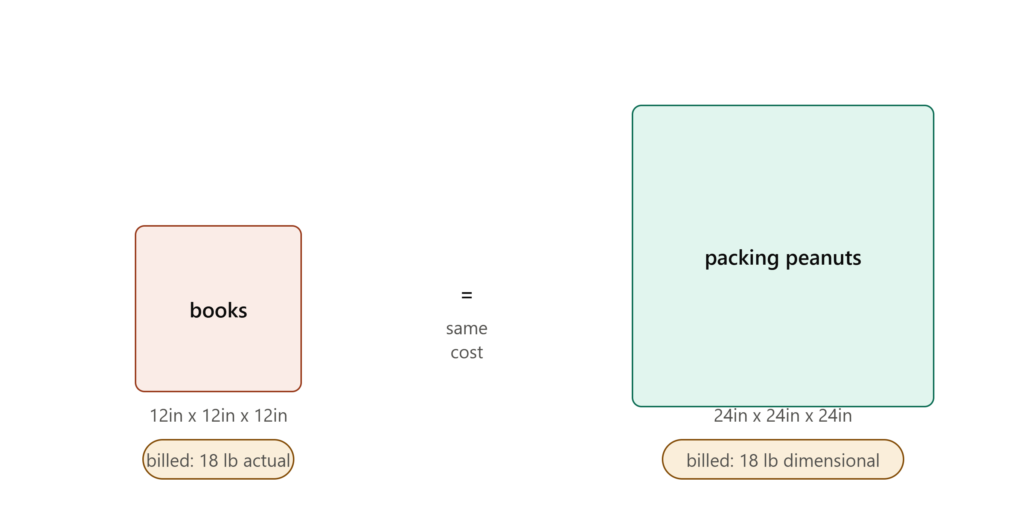
Dimensional weight (sometimes called volumetric weight) is a calculated weight based on the package’s size rather than how heavy it actually is. Carriers use this because a large, lightweight box (think a lampshade or a stack of pillows) still takes up truck and plane space that could otherwise carry heavier cargo. The formula generally works like this:
Dimensional weight = (Length × Width × Height) ÷ Dimensional factor
The dimensional factor varies by carrier and service type, often somewhere between 139 and 166 for inches, or a different divisor entirely for centimeters. Whichever number is higher — actual weight or dimensional weight — is what the carrier bills you for.
This is why a box of packing peanuts can sometimes cost more to ship than a much heavier box of books the same physical size. It’s also why compact, efficient packaging saves real money at scale — shrinking a box by even an inch or two on each side can shift dimensional weight into a cheaper pricing bracket.
A few practical weight tips:
- Weigh with packaging included. Never estimate based on the item alone; padding, boxes, and filler material all add up.
- Round up, not down. Most carriers round to the next whole pound or half-kilogram, so a package at 4.1 lbs is billed as 5 lbs.
- Split heavy shipments when it makes sense. Sometimes two mid-sized boxes cost less combined than one oversized, heavy box, particularly once dimensional weight and zone pricing are factored in.
Want to Track Speedx Package? Track Here
Frequently Asked Questions
Is shipping insurance worth it for low-cost items? For anything under $50 or so, many people skip it since the cost of insurance can eat into any savings. For higher-value, fragile, or irreplaceable items, it’s generally worth the small added cost for peace of mind.
Why did my shipping cost change after I paid? This usually happens when the actual weight or dimensions measured by the carrier don’t match what was entered when the label was purchased. Always double-check measurements before checkout to avoid this.
Can I ship internationally without knowing the destination’s customs rules? It’s possible, but risky — packages can get held, returned, or hit with unexpected fees if customs paperwork is incomplete. Most carriers provide customs forms and country-specific guidance during label creation to help avoid this.
Do shipping zones apply to every carrier the same way? The general concept is similar across major carriers, but the exact zone boundaries and pricing tiers differ. A zone 4 shipment on one carrier isn’t necessarily priced the same as zone 4 on another.
What’s the easiest way to avoid dimensional weight surcharges? Use the smallest reasonably protective box for the item, and avoid excessive empty space that inflates the package’s overall dimensions without adding real protection.
Does the type of box material affect shipping cost? Not directly — carriers price based on weight and dimensions, not material. However, sturdier packaging can reduce the risk of damage claims and rejected insurance claims down the line.
Final Thoughts
Shipping doesn’t have to be a guessing game. Once you understand how zones, dimensions, and weight interact to set a price — and how insurance and labeling protect the package along the way — the whole process becomes a lot less mysterious. Whether you’re shipping one gift or running a business that ships hundreds of orders a week, a little upfront knowledge goes a long way toward avoiding surprise fees and shipping headaches.